



|
New! Digital Interface System
PROBUS V
New!
Printer
friendly data sheet (PDF)
Overview:
(The values in this table are edge-values for
the resp. type range. The adjustment range for the power supplies usually is
beginning from zero.)
| Interface system |
Bus protocol |
Variant |
Comments |
What else is necessary: |
| Probus V |
IEEE 488 |
internal |
Embedded in the power supply, internal isolation 2 kV |
Computer with IEEE 488 - board,
IEEE 488 - connection cable,
software program to control
(Programming examples will be supplied) |
| external |
Potential difference up to some 100 kV, connection via optical fiber up
to 30 m |
|
RS 232 active |
internal |
Embedded in the power supply, internal isolation 2 kV |
Computer with serial interface,
serial connection cable,
software program to control
(Programming examples will be supplied) |
| external |
Potential difference up to some 100 kV, connection via optical fiber up
to 30 m |
|
RS 422 |
internal |
Embedded in the power supply, internal isolation 2 kV |
Computer with serial interface,
serial connection cable,
software program to control
(Programming examples will be supplied) |
| external |
Potential difference up to some 100 kV, connection via optical fiber up
to 30 m |
|
USB |
internal |
Embedded in the power supply, internal isolation 2 kV |
Computer with USB - connection,
USB- cable,
software program to control
(Programming examples will be supplied) |
| external |
Potential difference up to some 100 kV, connection via optical fiber up
to 30 m |
|
Profibus DP |
internal |
Embedded in the power supply, internal isolation 2 kV |
Computer or SPS with Profibus- interface,
Profibus- connection cable,
software program to control
|
| external |
Potential difference up to some 100 kV, connection via optical fiber up
to 30 m |
|
LAN (Ethernet) |
internal |
Embedded in the power supply, internal isolation 2 kV |
Computer or SPS with Ethernet board,
Ethernet- connection cable,
software program to control
|
| external |
Potential difference up to some 100 kV, connection via optical fiber up
to 30 m |
|
RS 232 passive |
only external |
Potential difference up to some 100 kV, connection via optical fiber up
to 30 m |
Computer with serial interface,
software program to control.
(Programming examples will be supplied) |
more versions on request
General:
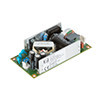
The modular interface system
PROBUS V
allows to connect FuG power supplies with various interfaces and
bus-systems.
Every version can be integrated completely into the power supply or delivered
with an external interface converter. In the last case the connection is
connected via optical fiber cables.
Features:
-
Easy programming with SCPI-like
syntax; Standard set of commands compatible to previous version PROBUS IV.
-
Extended set of commands for special
functions.
-
Most modern RISC-Microcontroller
techniques with SMD.
-
Completely digitally adjusted for
highest precision.
-
Isolation between interface converter
and ADDA component via optical fiber, though extremely immune against
interferences.
-
more than one ADDA components
addressable in one optical fiber chain.
Technical Data:
-
Instruction processing time approx.
300µs (without serial data transfer time)
-
at 625kBd at least 1000 settings per
second programmable (typ. 2000/sec)
-
up to 100 measurements per second
-
two outputs 0..+/-10V, resolution 17bit
incl. sign
-
setting time of outputs <500us
-
Tc < 1x10⁻⁵/K,
typ. 3ppm/K, better Tc on request
-
two inputs 0..+/-10V, programmable
resolution, max. 18bit incl. sign, input impedance >1GO
-
several digital I/Os for control of the
power supply
-
Optical connectors: Standard Agilent
(HP) HFBR-0500 series. Optionally HFBR-0400 series.
Design:
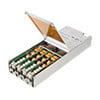
The
PROBUS V system
consist of two assemblies respectively:
-
Intelligent analog-digital and digital-analog
converter: (short: ADDA). This part always is in the power supply and
communicates by a serial ASCII protocol via optical fibers. It evaluates the
programmed commands, controls the power supply by reference voltages and
makes available serially the feed back data of the power supply.
-
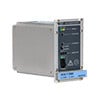
terface converter: This part
converts the optical signals to the respective bus- or interface standard.
The converter can be installed into the rear of the power supply unit or
delivered as a separate module. The external interface converters are
Euro-cassettes of 71mm (14TE) width, 133mm (3HE) height and 170mm depth. For
the passive RS 232 connection, the interface converter has the shape of a
Sub- D connector. The length of the optical fiber from the external
interface converter to the power supply may be up to 30m. (Synthetic
material fiber) resp. more than 1000m with special design (glass fiber).
to top of the page
IEEE 488:
-
Delay time of the data transfer:
<100us.
-
Baud rates on the serial side of the
optical link: 38400Bd or 625kBd selectable.
-
SRQ (Service Request) programmable.
-
LED indicators for "ad dressed" und "SRQ"
conditions.
-
together with ADDA commonly compatible
to the IEEE-488 mode of the predecessor PROBUS IV.
-
Optical connectors: Standard Agilent
(HP) HFBR-0500 series. Optionally HFBR-0400 series.
-
IEEE-488 address selectable by switch
near the IEEE-488 connector (outside the unit).Verzögerungszeit
der Datendurchleitung <100µs.
to top of the page
RS 232 active:
-
own power supply, 3-wire con
nection sufficient (Rx, Tx, GND).
-
Baud rates up to 115200Bd
possible.
-
Connector: 9-pol. Sub-D.
-
together with ADDA commonly
compatible to the RS- 232 mode of the predecessor PROBUS IV.
-
Optical connectors: Standard
Agilent (HP) HFBR-0500 series. Optionally HFBR-0400 series.
to top of the page
RS 232 passive:
Like RS 232 active, but:
-
Power supply by interface signals:
-
Optical connectors: Direct sticking
connection for standard 1mm POF optical link.
-
Guaranteed distance to the power
supply: up to 30m (typical up to 50m).
-
The complete interface converter is
housed in a Sub-D- connector-like case.
to top of the page
RS 422:
USB:
-
Control via virtual COM-Port or
directly via USB-driver.
(Virtual Com-Port driver for the most common operation systems available,
very simple programming, no USB-programming knowledge ne ces sary.)
-
Optical connectors: Standard
Agilent (HP) HFBR-0500 series. Optionally HFBR-0400 series.
-
Delay time typical approx. 1ms
due to USB principle.
to top of the page
Profibus DP:
-
An initial data block is made
available on the Profibus-DP side. Into this the primary SPS writes the
required set points and control commands.
-
This initial data block is
transferred cyclically by the converter via optical link to the ADDA part.
-
The feedback data (e.g.
measurements) of the ADDA part is questioned cyclically and provided n the
exit data block of the converter to the primary SPS.
-
Cycle time 40ms.
-
Profibus address selectable by
code-switch outside the unit.
-
Mode indication for Profibus
connection (red Error-LED).
-
Mode indication for optical link.
to top of the page
LAN (Ethernet):
-
Control via virtual COM-Port or
directly by TCP/IP-programming.
(Virtual Com-Port driver for the most common operation systems available,
very simple programming, no profound knowledge of TCP/IP-programming necessary.)
-
Optical connectors: Standard Agilent
(HP) HFBR-0500 series. Optionally HFBR-0400 series.
-
Delay time approx. 20ms.
to top of the page
zur deutschen Version
22.10.12 08:26 |